Fair Trade Coffee Innovation
In its 35-year history, the global Fair Trade model has not been significantly modified. Meanwhile, the realities of the market and global production have changed significantly. Fair Trade USA recognizes the need to evolve in light of these changes, and to keep Fair Trade coffee relevant and growing. The organization is exploring ways to innovate the Fair Trade Certified model to deliver greater value to all participating stakeholders – including producers and industry.
To accomplish this, Fair Trade USA is launching its Innovation for Impact Initiative and Coffee Impact Advisory Board composed of leaders and experts from the global coffee supply chain. Read on to learn more!
Innovation for Impact Initiative
The Innovation for Impact Initiative is a multi-stakeholder engagement and design lab aimed at developing a more scalable, higher-impact coffee program. Fair Trade USA is partnering with IDEO.org, an award-winning design consulting firm specializing in innovation for social impact. IDEO.org will deeply engage producers, industry, and other key stakeholders in the design process; develop prototypes for rapid testing and learning; help evaluate results; and support the subsequent roll-out of new program features, all with an eye toward increasing impact.
Reflecting the rich diversity and experience of the Fair Trade Certified community, the Coffee Impact Advisory Board will provide critical input and guidance on the Innovation for Impact Initiative and help define support for new program solutions.
Coffee Impact Advisory Board
Research
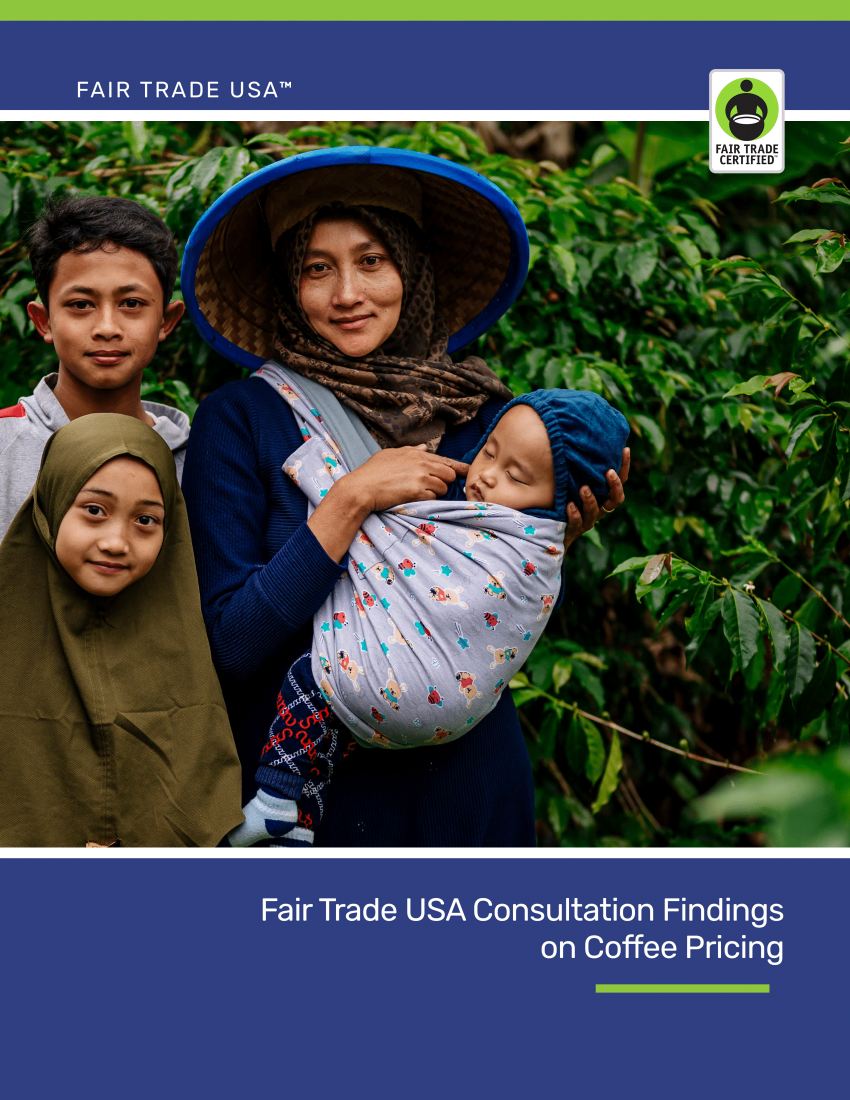
Fair Trade USA Consultation Findings on Coffee Pricing
Fair Trade USA undertook an extensive consultation to determine whether the fair trade movement is solving coffee producers’ biggest problems. This research also informed whether Fair Trade USA would increase the minimum price for coffee sold under its Fair Trade Certified™ label. This consultation process included surveys distributed to nearly 400 producers and over 500 industry representatives (roasters, importers, and brands), as well as in-depth interviews with producer organizations and industry stakeholders. The consultation reflected feedback representing 84% of U.S. fair trade coffee volumes.
Fair Trade Coffee Program Updates
August 5, 2026
Fair Trade USA Coffee Pricing Update
On July 30, 2026, Fairtrade International announced an increase to its Fairtrade Minimum Price for coffee, effective for contracts signed on or after December 1, 2026.
Fair Trade USA™ is assessing its coffee pricing within the context of the United States market. Current Fair Trade USA pricing terms remain in effect while that assessment is underway. This reflects our responsibility to determine the pricing approach that best supports producer outcomes in the markets where our program operates.
The coffee sector has experienced a dramatic swing in the three years since Fairtrade International’s last minimum price increase. In that time, production costs have risen. Weather has grown less predictable. In the United States specifically, tariffs and supply chain disruption have made commercial conditions materially harder for the companies that buy certified coffee.
The minimum price is a safety net and the market has been at historic highs. This simply means that the minimum price has not been in play in recent years. That does not make the Minimum Price unimportant. It does mean that it is not, at present, what determines most of what producers earn. Volume is. Producers earn the Premium, and the organic differential on the coffee that is actually bought on Fair Trade terms.
Our responsibility to producers is to ensure that their market access is protected and meaningful while keeping their participation commercially viable. This is especially true in the currently price-sensitive U.S. market.
Our market assessment will include available market information, publicly available research, our own experience in the United States market, and direct stakeholder engagement across the supply chain, including producer organizations, importers, roasters, brands, and retailers.
We are not starting from zero. We have been engaging partners on coffee pricing on an ongoing basis, and this announcement is an opportunity to consolidate that work into a single review.
We expect to complete this assessment and communicate a decision within the next two months.
When minimum prices were last revised in 2023, we conducted a formal consultation across the United States market and among producers. The clearest message from producer organizations was about how much of their harvest they are able to sell on Fair Trade terms. Asked which changes to the model would most help their businesses grow, the largest share of responses pointed to new markets, stronger demand, and more active communication to consumers.
Industry partners indicated that an increase in the minimum price would lead to a decrease in demand and many walking away from Fair Trade altogether. Loss of volume hurts producers, so we are committed to revisiting these findings and checking them against current market realities before coming to a determination.
What this means for partners
- The current Fair Trade USA Minimum Price, Premium, and Organic Differential remain unchanged.
- Existing contracts continue under the pricing terms agreed by the contracting parties.
- Service fees for licensed partners are separate from price and Premium and are unchanged.
- Coffee traded under Fairtrade International terms continues to be accepted within Fair Trade Certified™ supply chains through the Fair Trade USA Recognition Program.
- Contracts using Fair Trade USA pricing continue to reference the applicable Fair Trade USA pricing terms and the Fair Trade USA IDs of both buyer and seller.
A detailed FAQ accompanies this statement.
Questions
|
Industry partners |
Your Fair Trade USA account manager, or coffee@fairtradeusa.org |
|
Producer partners |
Producer Services, or infocert@fairtradeusa.org |
|
Media |
5 de agosto de 2026
Actualización de Precios de Café de Fair Trade USA
El 30 de julio de 2026, Fairtrade International anunció un aumento a su Precio Mínimo Fairtrade para café, vigente para contratos firmados a partir del 1 de diciembre de 2026.
Fair Trade USA™ está evaluando su estructura de precios de café en el contexto del mercado de Estados Unidos. Los términos de precios actuales de Fair Trade USA permanecen vigentes mientras esa evaluación está en curso. Esto refleja nuestra responsabilidad de determinar el enfoque de precios que mejor apoye los resultados de los productores en los mercados donde opera nuestro programa.
El sector cafetero ha experimentado un giro drástico en los tres años transcurridos desde el último aumento de precio mínimo de Fairtrade International. En ese tiempo, los costos de producción han aumentado y los productores a menudo enfrentan un entorno climático cada más incierto. En Estados Unidos específicamente, los aranceles y las interrupciones en la cadena de suministro han hecho que las condiciones comerciales sean materialmente más difíciles para las empresas que compran café certificado.
El precio mínimo es una red de seguridad que protege a los productores cuando los precios de mercado caen. En los últimos años, el mercado ha permanecido por encima de ese nivel con máximo históricos, por lo que el Precio Mínimo no ha sido el factor que ha determinado el precio recibido por las ventas Comercio Justo. En el contexto actual, los ingresos de los productores dependen en gran medida del volumen de café que logran comercializar bajo términos Fair Trade, ya que es sobre esas ventas que reciben la Prima Fair Trade y, cuando corresponde, el diferencial orgánico. Por ello, nuestra evaluación busca considerar tanto las condiciones de mercado como las oportunidades para mantener y fortalecer el acceso de los productores a los mercados Fair Trade.
Nuestra responsabilidad ante los productores es que su acceso al mercado esté protegido y sea significativo, manteniendo al mismo tiempo que su participación sea comercialmente viable. Esto es especialmente cierto en el mercado estadounidense, actualmente sensible al precio.
Nuestra evaluación del mercado incluirá información de mercado disponible, investigaciones de acceso público, nuestra propia experiencia en el mercado de Estados Unidos y la interacción directa con actores clave a lo largo de la cadena de suministro, incluidas organizaciones de productores, importadores, tostadores, marcas y minoristas.
No estamos empezando de cero. Hemos estado trabajando con los socios en el tema de precios de café de manera continua, y este anuncio es una oportunidad para profundizar y completar nuestra revisión y comunicar la decisión.
Cuando los precios mínimos se revisaron por última vez en 2023, realizamos una consulta formal con diversos actores del mercado de Estados Unidos y con organizaciones de productores. El mensaje más claro de las organizaciones de productores fue sobre cuánto de su cosecha logran vender bajo términos de Fair Trade. Al preguntarles qué cambios al modelo ayudarían más a que sus negocios crecieran, la mayor proporción de respuestas señaló nuevos mercados, demanda más fuerte, y comunicación más activa hacia los consumidores.
Durante esa consulta, socios de la industria indicaron que su preocupación de un aumento en el precio mínimo llevaría a una disminución en la demanda y a que muchos se alejaran de Fair Trade por completo. La pérdida de volumen perjudica a los productores, por lo que estamos comprometidos a revisar estos hallazgos de nuevo y contrastarlos con las realidades actuales del mercado antes de llegar a una determinación.
Qué significa esto para los socios
- El Precio Mínimo, la Prima y el Diferencial Orgánico actuales de Fair Trade USA permanecen sin cambios.
- Los contratos existentes continúan bajo los términos de precios acordados por las partes contratantes.
- Las tarifas de servicio para los socios licenciados son independientes del precio y la Prima, y permanecen sin cambios.
- El café comercializado bajo los términos de Fairtrade International puede seguir formando parte de las cadenas de suministro de Fair Trade Certified™ a través del Programa de Reconocimiento de Fair Trade USA, siempre que cumpla con los requisitos del programa.
- Los contratos que usan precios de Fair Trade USA continúan haciendo referencia a los términos de precios aplicables de Fair Trade USA y a los IDs de Fair Trade USA tanto del comprador como del vendedor.
Un FAQ detallado acompaña este comunicado.
Preguntas
| Socios de la industria | Su gerente de cuenta de Fair Trade USA, o coffee@fairtradeusa.org |
| Socios productores | infocert@fairtradeusa.org |
| Medios | pr@fairtradeusa.org |
June 13, 2024
Fair Trade USA reaffirms coffee market stabilization strategy through 2025
A year after deciding to stabilize the market for Fair Trade Certified coffee, Fair Trade USA (FTUSA) is announcing the continuation of current pricing through the end of 2025. This decision means that the FTUSA minimum price and premiums will remain the same for at least another 18 months.
This decision was made with deep market analysis and ongoing stakeholder consultation. Coffee markets are experiencing extraordinarily high prices and volatility with resulting disruption to consumer demand, inventory levels, and producer sales. We believe that in order to deliver on our mission of eliminating poverty and promoting sustainable development for coffee producers, it is imperative to prioritize market stability in these times of extreme uncertainty.
We came to this decision by listening deeply to both producer and industry partners. These key stakeholders want to protect the current Fair Trade Certified market share developed over the last 25 years (200M pounds in the U.S. market) and the resulting impact to over 600,000 coffee farmers and their families worldwide.
In our consultation, we heard once again that the primary goal of producers today is to increase the volumes that they are able to sell on Fair Trade terms. Our outreach shows that a third of industry and producer representatives believe that maintaining the current price will increase demand. Over 65% believe that keeping the market stable is the best path to long-term viability and scalability. We also heard from both that raising the minimum price or premium would result in a high risk of decreasing demand within the North American market, with over 60% of respondents believing that demand for organic Fair Trade Certified coffee would be the most vulnerable. Our decision to prioritize market stability is directly informed by the collective insights and guidance of our stakeholders.
FTUSA will review its coffee minimum price and premium again in mid-2025 in consultation with stakeholders. We will announce our pricing policy for 2026 at that time.
Notably, FTUSA has articulated a vision and strategy for farmer impact that is based on growing sales volumes. Price stabilization is a key component of this strategy. Innovation that adds value and relevance to the Fair Trade model is the other pillar of our strategy. Toward that end, we are leveraging the expertise of our internal teams, external consultants, our esteemed Coffee Impact Advisory Board, and our trusted Council of Coffee Producer Leaders to continue exploring innovation efforts that unlock even more value and impact for producers and industry partners.
For example, at the annual Specialty Coffee Association (SCA) trade show in April, we convened over 160 coffee producer leaders from a dozen countries around the world to discuss the current market volatility, our volume-focused strategy for impact, and model innovation. Some of the key initiatives discussed included: European Union Deforestation Regulations (EUDR) compliance; supporting and monetizing climate-friendly practices such as regenerative agriculture; and developing the technological capabilities to enhance supply chain transparency and deliver stronger access to producer impact data. With regard to this last initiative, we believe that “data on demand” – for industry, consumers, and producers – is critical to meet growing stakeholder demand for supply chain insights and content. These insights will allow producers and industry to better understand risks, enhance outcomes, and partner more effectively to bring more Fair Trade Certified coffee to market. Investing in technology, data, and content will also allow us to offer consumers more opportunities to connect with the farmers behind the beans that they buy, driving greater demand.
We will continue to share updates as we test, learn, and iterate our initiatives. After 25 years of market and movement building in the United States, we are proud of our collective impact. Clearly, we have helped evolve the global coffee market toward more responsible, sustainable practices – benefitting millions of farmers and their families. At the same time, we are humbled by how far we have to go. We seek to help improve the lives of coffee farmers, contribute to the development of rural communities, and protect the environment – at scale. We are committed to partnering with producers and industry to achieve that vision. And we have heard them clearly: during these turbulent times of market volatility, stabilizing the Fair Trade price and premium – combined with model innovation – are the best strategies for growing the impact of our global movement.
October 11, 2023
Fair Trade USA will maintain the minimum price and premium for Fair Trade Certified coffee during 2024
Now several months into our ongoing work to determine the future vision of Fair Trade Certified coffee with the Coffee Innovation Advisory Board and IDEO.org, it is clear that keeping the market for Fair Trade Certified coffee stable is a priority. Consumer confidence continues to decrease as inflation rose again last quarter, and stakeholders continue to express concern about their ability to increase volumes in an uncertain economy. This is backed by new numbers from the Coffee Barometer Report showing a steady increase of supply of Fair Trade coffee over the last 4 years, but with demand moving at a slower pace. The inability to sell fair trade coffee on fair trade terms is the biggest risk that coffee farmers face.
With impact our north star, maintaining and increasing the demand for Fair Trade Certified coffee is our priority. Therefore, aligned with the need to ensure stability in the market, Fair Trade USA is announcing that no changes to the minimum price and premium for Fair Trade Certified coffee will go into effect in 2024. This will allow us to partner with producers and industry to continue growing the market and consumer demand, while also ensuring enough time for the full due diligence that coffee producers deserve, and the market needs. We will continue to leverage the expertise of the Coffee Impact Advisory Board and IDEO.org and will ensure sufficient lead time if any changes are deemed appropriate in 2025.
—
Leer en Español:
Fair Trade USA mantendrá el precio mínimo y la prima para el café Fair Trade Certified durante el 2024
Tras varios meses de trabajo para determinar la visión de futuro del café certificado de Comercio Justo con la Junta Consultiva de Innovación del Café e IDEO.org, está claro que mantener estable el mercado del café certificado de Comercio Justo es una prioridad.
La confianza de los consumidores sigue disminuyendo a medida que la inflación aumentó de nuevo el trimestre pasado, y las partes interesadas siguen expresando su preocupación por su capacidad para aumentar los volúmenes en una economía incierta. Esto se ve respaldado por las nuevas cifras del Informe del Barómetro del Café, que muestran un aumento constante de la oferta de café de Comercio Justo en los últimos 4 años, pero con una demanda que avanza a un ritmo más lento.
La dificultad de vender café de comercio justo en condiciones justas es el mayor riesgo al que se enfrentan los caficultores. Siendo el impacto nuestro objetivo, el mantener y aumentar la demanda de café certificado de Comercio Justo es nuestra prioridad. Por lo tanto, en consonancia con la necesidad de garantizar la estabilidad en el mercado, Fair Trade USA anuncia que en 2024 no entrará en vigor ningún cambio en el precio mínimo y la prima para el café Fair Trade Certified, comercializado bajo condiciones de Fair Trade USA.
Esto nos permitirá asociarnos con los productores y la industria para seguir haciendo crecer el mercado y la demanda de los consumidores, garantizando a la vez el tiempo suficiente para la debida diligencia que los productores de café merecen y el mercado necesita.
Seguiremos aprovechando la experiencia de la Junta Consultiva sobre el Impacto del Café y de IDEO.org, y garantizaremos un plazo suficiente en caso de que se considere oportuno realizar algún cambio en 2025.
July 6, 2023
Fair Trade USA Maintains Current Coffee Price and Premiums, Launches ‘Innovation for Impact Initiative’
Fair Trade USA will maintain current minimum prices and premiums for all coffee sold under its Fair Trade Certified™ label through the end of 2023.
Simultaneously, it is launching a groundbreaking, multi-stakeholder Innovation for Impact Initiative, aimed at building consensus between industry and producers around a renewed, more scalable, higher-impact Fair Trade Certified program.
This strategic decision comes after a comprehensive stakeholder consultation and listening tour over the last two months. Through surveys and direct interviews, Fair Trade USA engaged over 500 roasters, importers, and retailers and nearly 400 producer organizations. Participants who responded to the consultation represent over 84% of all Fair Trade Certified coffee sold in the U.S. market, which was 210 million lbs. in 2022. 63% of survey respondents were producers and 37% were industry partners (roasters, importers, and retailers).
The major finding: the overwhelming majority of these companies warned that an increase in price in the current inflationary environment would significantly lower demand and volume over the next 12-24 months, reducing overall producer impact. Over 60% of the respondent roasters, importers, and retailers advised Fair Trade USA not to implement a price increase.
While many producer leaders interviewed supported the price increase in principle, they also expressed concerns about the magnitude of the increase, the timeline for implementation, and the risk of reduced market demand. Most producers only sell small percentages of their total production on Fair Trade terms, so their primary goal is to secure and increase demand.
In response, Fair Trade USA is launching the next phase of its multistakeholder engagement, the Innovation for Impact Initiative. This initiative will enlist broad, creative input from industry and producers, aimed at renewing the Fair Trade Certified coffee program for impact through volume and scale. The global Fair Trade model, which has not been significantly modified in its 35-year history, will need to evolve and deliver greater value to all participating stakeholders to remain relevant and grow.
Important improvements to the Fair Trade USA coffee program will be made through multi-stakeholder engagement, meaningful dialogue, and consensus-building between industry and producers. Fair Trade USA plans to design and develop the new program over the next 3-4 months with implementation of program improvements in 2024, taking into consideration implementation timelines.
To guide and support the Innovation for Impact Initiative, Fair Trade USA is creating a diverse, global Coffee Impact Advisory Board. Rüdiger Meyer, the founder and former CEO of FLOCERT, will chair this Board. Lindsey Bolger, former SVP and Managing Director of Keurig Trading; Carlos Vargas, General Manager of CoopeTarrazú, the largest Fair Trade coffee cooperative in Costa Rica; and Guido Fernandez, EVP of the Colombian Coffee Federation, are a few of the other distinguished Board members. The rest of the Board will be formally announced in the next few weeks.
Fair Trade USA is the leading third-party certifier of Fair Trade products in North America. As an independent organization with a 25-year track record of market- and movement-building, Fair Trade USA is not required to follow pricing set by Fairtrade International (FLO). Its past adherence to Fairtrade International’s minimum price and premium was purely voluntary.
Fair Trade USA is free and able to set a different policy if it finds that is in the best interest of its mission and stakeholders, which is currently the case.
For importers, roasters, and retailers currently working with Fair Trade USA, little will change in the months ahead. The minimum price ($1.40/lb. for washed Arabica, $1.05/lb. for washed Robusta), social premium ($0.20/lb.) and organic differential ($0.30/lb.) will all remain the same. Authorized producers, cooperatives, and exporters will also remain the same. New guidance on contracting and reporting will be issued in the next few weeks, but changes are expected to be minor. The Fair Trade USA team will continue to closely support our 500+ coffee industry partners through the transition.
As background, on March 30, 2023, Fairtrade International (FLO) announced it will raise its coffee minimum price and organic differential, effective August 1, 2023. This decision was aimed at addressing the rising cost of production for producers. In an effort to ensure that its stakeholders were properly engaged and heard, Fair Trade USA conducted its own stakeholder consultation that began in April and ran through June 2023, leading to the decisions being announced today.
Fair Trade USA will publish a report on the findings of its consultation and listening tour in the coming weeks. It will continue to provide program updates to all stakeholders. For additional questions, please email coffee@fairtradeusa.org. In addition to the frequently asked questions below, please reach out to pr@fairtradeusa.org with any media request.
Are you a Fair Trade Certified industry partner or producer and didn’t get a chance to share your thoughts? Reach out to coffee@fairtradeusa.org to get the survey.
May 3, 2023
We heard great enthusiasm and solidarity among the industry around the needs of producers and the hopes for a higher price for their coffee that fully covers the high costs of production. We also heard a considerable amount of confusion and nervousness regarding the timing of the announcement as well as feelings of limited engagement in advance of such a large and rapid adjustment to the model. The main concern expressed by multiple stakeholders is that this adjustment could cause a reduction in market demand that could threaten the impact of a higher price.
We received positive feedback for our decision to launch our own consultation with the North American coffee industry allowing producers to better understand the possible repercussions of a significant increase in the price for Fair Trade Certified coffee. This will allow the 500+ importers and roasters that work with our seal in this market the opportunity to have their voices and perspectives heard in the process. We believe it is important to take the necessary time for such a consultation. Details on the formats and options for consultation will be coming in the next few weeks.
Following this consultation, we will convene roundtable-style dialogue opportunities to enable direct conversation between producers and industry. This will allow all parties to share perspectives and reach positions that are viable for both, aimed at ensuring growing impact for producers in the years ahead. Fair trade is an alliance based on shared interest and mutual benefit. We believe it is crucial to open space for dialogue, mutual understanding and innovative solutions before arriving at any determination.
In the meantime, we will honor all Fair Trade Certified coffee contracts at the current price and premium levels. We will also make sure that our partners have access to timely information on any potential changes in our program. We will be providing updates regularly over the coming weeks.
For additional questions, please reach out to your Fair Trade USA account manager or email coffee@fairtradeusa.org.
Media inquiries can be sent to pr@fairtradeusa.org
April 7, 2023
Over the last 25 years, as the leading third-party certifier of fair trade products in North America, we believe the fair trade model is most successful when industry and producers are fully and strategically aligned. At its best, fair trade certification is a win-win partnership in which farmers, cooperatives, companies, and consumers all thrive together. Therefore, important changes to fair trade standards are best made through multi-stakeholder engagement and meaningful dialogue in which parties can co-create their shared future.
Fair Trade USA is launching its own coffee industry stakeholder consultation. The objective is to fully include and engage companies and producers operating in the North American market under the Fair Trade Certified seal. This consultation will address not only coffee prices but more broadly how fair trade certification can continue to innovate for greater impact in the future. We are eager to listen and learn.
Our commitment to the fair trade community is to share rich and informative feedback with trust and transparency. In the coming months, we will convene a multi-stakeholder review of the consultation results and create a genuine dialogue between the U.S. coffee industry and the producers selling into this market. This discussion will directly inform Fair Trade USA’s decisions regarding any changes to the standards for coffee sold under the Fair Trade Certified seal.
In the meantime, we will honor all Fair Trade Certified coffee contracts at the current price and premium levels. We will also make sure that our partners have access to timely information on any potential changes in our program. We will be providing updates regularly over the coming weeks.
For additional questions, please reach out to your Fair Trade USA account manager or email coffee@fairtradeusa.org.
Media inquiries can be sent to pr@fairtradeusa.org.
Frequently Asked Questions
On July 30, 2026, Fairtrade International announced an increase to its Fairtrade Minimum Price for coffee, effective for contracts signed on or after December 1, 2026. Fair Trade USA™ is assessing its coffee pricing in the context of the United States market. Current Fair Trade USA pricing terms remain in effect while that assessment is underway. These questions cover what the review does and does not change.
Has Fair Trade USA decided whether to adopt Fairtrade International's new coffee pricing?
No final decision has been reached. Fair Trade USA is reviewing its coffee pricing and engaging stakeholders across the supply chain. Current Fair Trade USA pricing remains in effect during the review.
When will Fair Trade USA make a decision?
Fair Trade USA expects to complete the review and communicate a decision within the next 2 months. We will publish the outcome and any resulting changes on this page.
Is Fair Trade USA required to follow Fairtrade International's pricing?
No. Fair Trade USA is an independent organization and sets the standards and pricing that apply to coffee traded under the Fair Trade Certified™ label. Fairtrade International sets the terms that apply within its system. Past alignment between the two Minimum Prices was voluntary.
Are the two systems currently aligned?
No. The systems currently have different Minimum Prices and different organic differentials. Partners continue to apply the terms of the relevant system to each transaction.
What are the current Fair Trade USA coffee prices?
All pricing will remain the same and can be found on the Price & Premium page here.
What changes during the review?
Nothing changes during the review. Fair Trade USA pricing, contracts, certification requirements, reporting processes, and service fees remain unchanged. Partners continue to identify the applicable system for each transaction and apply the corresponding terms.
What evidence will inform the review?
The review draws on available market information, publicly available research, prior and ongoing stakeholder engagement, and Fair Trade USA’s experience in the United States market. It also considers the value provided through Fair Trade USA standards, assurance, and producer support.
What did Fair Trade USA's 2023 consultation find?
In 2023 Fair Trade USA conducted a formal stakeholder consultation and listening tour across three months, engaging more than 500 roasters, importers, and retailers and nearly 400 producer organizations, together representing over 84 percent of Fair Trade Certified coffee sold in the United States market. More than 60 percent of companies disagreed with the minimum price increase and 77% indicated that a price increase in that environment would significantly lower demand and volume. More than two thirds of responding roasters, importers, and retailers advised against implementing an increase.
While just over 50% of producer survey respondents supported an increase, the same number articulated that they believed it would negatively impact demand and volume. Producer organizations most often identified the share of their harvest they are able to sell on Fair Trade terms as their most pressing constraint, rather than the level of the floor.
How does the review treat the Minimum Price and the organic differential differently?
The Minimum Price operates as a safety net and takes effect when the market reference price falls below it. The organic differential is paid on every organic pound regardless of where the market is trading. The two mechanisms therefore behave differently in current market conditions, and the review covers the complete pricing structure rather than the Minimum Price alone.
Does this mean the Minimum Price is unimportant?
No. The Minimum Price is a safety net and it does its work when markets fall. It stays in place. The question under review is what the whole pricing structure should be for this market, not whether a floor should exist.
Fairtrade International's price is informed by cost-of-production research. Is Fair Trade USA's?
We do not dispute that production costs have risen materially, or that many producers face real difficulty sustaining their farms and organizations. The question is whether the market can absorb a higher cost of participation without reducing the volume sold on Fair Trade terms. Ultimately, a higher price cannot benefit producers if the resulting decline in demand means that fewer certified volumes are purchased.
What else is Fair Trade USA doing to increase what farmers can earn?
Alongside this review we are making investments to boost ways for farmers to earn from the value chain itself. Through various partnerships coffee and cocoa farmers can participate in agroforestry-based carbon removal, and farmers retain ownership of their data. We are also developing biodiversity finance models that recognize the role farmers play in protecting and restoring ecosystems. Additionally, we are also building systems so that the impact data generated in our program is usable by, and owned by, the producers who generate it.
Are these programs delivering additional income to farmers today?
Several are at pilot or design stage. We will report results as evidence accumulates rather than ahead of it. We would rather describe this work accurately than overstate it.
What does the review mean for current Fair Trade USA contracts?
Nothing changes during the review. Fair Trade USA pricing remains in effect, and existing contracts remain subject to the terms agreed between buyer and seller. Partners continue using current pricing and documentation processes.
What happens to contracts extending beyond December 1, 2026?
For coffee traded on Fair Trade USA terms, current Fair Trade USA pricing and procedures continue to apply during the review, so the December 1 date does not alter those contracts. Coffee traded on Fairtrade International terms remains subject to Fairtrade International’s applicable contract and transition rules. Your Fair Trade USA account representative can review specific contracts with you.
Will Fair Trade USA service fees change?
No. The Minimum Price, Premium, and organic differential are contractual payments within the coffee supply chain. They are separate from Fair Trade USA service fees, which are not affected by the pricing review.
Will reporting or certification requirements change?
No. The review does not change Fair Trade USA certification, transaction reporting, traceability, or documentation requirements. Partners continue following existing Fair Trade USA procedures.
Can companies continue sourcing from FLOCERT certified producer organizations?
Yes. Eligible producer organizations holding a valid FLOCERT certificate may participate in Fair Trade Certified supply chains through the Fair Trade USA Producer Recognition Program, subject to the program’s requirements. Commercial partners should work with their Fair Trade USA account representative to confirm eligibility and transaction requirements.
What does the review mean for producers selling into Fair Trade Certified supply chains?
Current Fair Trade USA Minimum Prices, organic differential, and Premium remain in effect during the review. Producers retain the ability to negotiate prices above the applicable minimum with buyers. Fairtrade International pricing applies to contracts traded under Fairtrade International terms.
What value does Fair Trade USA provide beyond pricing?
Fair Trade USA combines price and Premium requirements with standards, independent assurance, producer support, market access, traceability, labor protections, governance and participation requirements, environmental practices, and climate resilience work. Fair Trade value is not limited to the volume sold on Fair Trade terms.
Who should I contact?
For contracts, volumes, and partner-specific pricing, contact your Fair Trade USA account representative. For certification, recognition, and reporting, email certification@fairtradeusa.org. For general coffee program questions, email coffee@fairtradeusa.org. For media inquiries, email pr@fairtradeusa.org.
Where will updates be published?
Updates and additional information will be posted on this page.